
(by Martin OL5Y and Vaclav OK6RA/OL9R)
What it's all about
(those in the know can skip this chapter)
WRTC (World Radiosport Team Championship) is the most prestigious global competition in amateur radio contesting and is often referred to as the Ham Radio Olympics (as it usually takes place once every 4 years). Its goal is to compare the skills of the world's best operators under maximum equality of conditions, with all teams using identical locations, antennas, and output power.
WRTC always takes place concurrently with the IARU HF World Championship contest in July, with competitors making contacts with the same stations as other participants in this contest. However, for WRTC purposes, a separate scoring and multiplier system applies (multipliers are DXCC entities and HQ stations).
The latest edition, WRTC 2026, took place in Great Britain, where the organizers built 55 identical competition stations, 5 of which served as reserves in case of problems. Each team consists of two operators who can operate simultaneously without role restrictions. However, the rules specify that a single operator may listen to only one receiver at any given moment and display the spectrum of only the band they are currently working on. Each team is accompanied by an independent referee overseeing compliance with the rules.
Participation in WRTC is not a matter of nomination, but of long-term qualification. Applicants earn points in a series of major international contests during a multi-year qualification period. A total of 50 teams were selected for the 2026 edition, 40 of which emerged from qualification. The field of competitors was further complemented by defending champions, youth teams, sponsored teams, and a wild card team chosen by the organizer. Alongside the one hundred competitors, 50 referees and an extensive team of volunteers participate in the event, handling the technical, organizational, and logistical aspects of this extraordinary ham radio event.
Qualification
Those of you who follow WRTC and qualification criteria know that it is always a huge topic in the contesting community. Of course, there are always plenty of dissatisfied people and various ideas going from one extreme to another. I managed to qualify for WRTC in Brazil (2006), but due to the collapse of the airline company, my teammate Jirka OK2RZ and I never made it there… Then there was the WRTC in Russia (2010), where I didn't want to travel. Before WRTC 2014 in the USA I had other activities going on :-) And then I tried SO2R and found out that this is what I want to do. Since then I operate exclusively LP (not counting guest operations abroad) - what led me to this is a long story outside the topic of WRTC :-) So I follow the qualification conditions mainly from the perspective of how they treat LP. For 2018 in Germany it was great – LP categories were equal to HP. However, at that time I had no place to compete from :-) And because a number of cheaters allegedly qualified for the German WRTC from the LP ranks, the opposite extreme was chosen for the following WRTC 2022 in Italy – penalizing LP with a coefficient of 0.9. Which, after a quick calculation, I assessed as unrealizable. When the qualification rules for 2026 were published, with a coefficient of 0.95 for LP and a favorable layout of our qualification area (DL, OE, OK, OZ, HB9, HB0) along with caps on the number of stations from individual DXCCs, I became convinced that qualifying was not impossible. At that time, one thing was certain – if it works out, I will go with Vaclav OK6RA, as my greatest honest competitor in the LP category :-)
Since another coefficient for calculating qualification points was related to assistance (SO=1, SOA=0.95), I stopped operating with a cluster and started un-assisted (which came in handy for WRTC later as well). I also changed my "antenna strategy" and built 3 new monobanders at the beginning of 2025. Every contest was unique in some way – this too would make a long story :-) I think it wasn't certain that it would work out until the end of 2024.
What I think is worth mentioning, though: 6 of the 8 qualifying contests counted for me were CW and one MIX. 4 times I got "full points" (subsequently reduced by the 0.95 coefficient). And a fun detail to wrap up: Vaclav and I were the only ones at WRTC who qualified exclusively from LP categories.
Vaclav writes regarding qualification: Qualifying for WRTC takes quite a bit of work, preparation, and mental resilience. Especially in the LP category, where people are constantly trying to squeeze out of you how much power you actually run and that it's impossible for you to place in TOP 10 in the world in major contests with modest equipment. That made it an even bigger challenge for me. Michal OK1M came up with a great idea in 2020 to rent 1 room at an old missile base near Kladno. On a fairly modest setup, we built dipoles for 160/80m, a vertical for 80m, and an 18 m high mast on the building's roof with a 13el multiband antenna. In the world of big WRTC competitors, a below-average setup. The handicap of living in the center of Prague was somewhat compensated by setting up a remote connection.
From that year on, I started crossing paths on the bands with Martin in the LP category, and there was no need to look for a better WRTC partner even though we had never operated a contest together before. The choice was clear and the agreement simple.
I contest exclusively in the assisted category because it is easier and eliminates any debates over whether I found a multiplier, say, by squinting at the DX cluster – even though for WRTC qualification it is a disadvantage in the form of a lower coefficient compared to other categories.
So I operated 3 qualifying contests remotely from Prague, 4 contests directly from the QTH, and 1 counted contest while on a family vacation in EA8. In 4 contests I scored the most points in our qualification area. An interesting coincidence was that in EA8 I operated on only one band as SO(A)20 LP, but since no one in the all-band LP category from this part of Africa managed to achieve a better score, I also got full qualification points.
Training contest IARU HF Championship 2025
As part of our preparation for WRTC, Vaclav and I participated in the IARU contest in the M/2, LP category. A year before the main event, we secured the special callsign OL26WRTC to both promote WRTC and enjoy operating with a new prefix. Our main goal was to test the mutual isolation/immunity of our radios, the functionality of the triplexer, filters, and other equipment. And of course to "sit side by side" for longer than just a few hours :-) – up to that point, we hadn't operated any contest together.
It started with a logistical issue and a traffic jam that trapped Vaclav on the highway, leaving us with only about 2 hours for pre-contest setup instead of the planned five. As it later turned out during WRTC itself, even this delay was good practice for a real situation :-) Unfortunately, I also had a problem on my end starting Saturday morning – my "contest PC" died, so I had to install everything from scratch on another one. We plugged everything in relatively quickly, and the final step was connecting both PCs into the N1MM network. That's where we struggled for a long time (mostly Vaclav, as I'm not very comfortable with "IP networking"). We studied the manual, googled, consulted various AI models, but all procedures failed – always ending with the message "Starting" (those who have ever set up an N1MM+ network know the message; for others it's not important, hi). About 5 minutes before the start of the contest, we were at our wits' end. Even though we had restarted both the SW and PCs several times during our attempts, we said "let me try it again". Well, it probably won't surprise anyone that since I'm emphasizing this, it actually worked this time. Vaclav summed it up perfectly: "anything that smells of IP is a problem".
So we started with a slight delay, but it didn't even rattle us. We just told ourselves that if this happened right before WRTC, we'd probably have a heart attack. Little did we know… The strategy was to make the best possible result point-wise – who would have thought, right? :-) Meaning looking for higher-point QSOs and rigorously chasing multipliers. Running CQ from our location made sense only in certain bands/times, so we spent a large part of the contest searching. And that can be done without a DX cluster for the entire contest without any boredom whatsoever – there is always something to find somewhere. However, calling stations with such a callsign is absolute madness. I think about 1/3 of called stations logged us incorrectly despite our best efforts. Having operated several contests with portable prefixes (IH9/OL5Y and IM0/OL5Y), I have some experience with long callsigns. But this was a whole new level. I think the most popular mangled versions were OL2/RTC and OL2BWRTC. I occasionally startled Vaclav with a shout of joy whenever a station copied me on the first try – and I was strictly sending at a maximum speed of 27 WPM. Over the whole contest that happened maybe 8 times – I started taking notes, but then mislaid the paper, so I don't have the list of stars. This topic of "button-clickers" versus OPERATORS is a long story – and maybe nobody cares, so I'll end it here. Nevertheless, this was reflected in our QSO rates.
So to get back to the contest and our other huge handicap: RBN. When we called CQ on CW, stations weren't calling us much. We discovered that skimmers weren't picking us up, or rather our callsign wasn't passing into RBN. More precisely, on Saturday it didn't pass through at all on 15m; on 20m it somehow worked. With my normal callsign I generate dozens of spots; with ours, ZERO. To be honest, I don't quite understand how callsign filtering in RBN works – I'm just describing our actual experience. On other bands spots were sporadic, in any case an order of magnitude fewer than I am used to with the same equipment. On Sunday we noticed about 4 spots on 15m as well. This whole spot farce affected our rates – pushing us into searching even more.
Otherwise, we both had a blast, but also experienced tremendous fatigue and nodding off during QSOs. At night 20 meters was wide open, with dozens of US stations from zone 6 calling us. 40m was also working great. Despite the long callsign and the resulting slow CW speed of 27 WPM, our rates on 20m were consistently around 150, occasionally over 200. After sunrise we were exhausted – partly because contacts were coming in much slower. Personally, I fell asleep several times right in the middle of a QSO, or while repeating our CALL several times – apologies to everyone I suddenly disappeared on :-). Halfway through the contest we didn't think we'd reach 2,000 QSOs – but in the end we managed it. Although we weren't among the stars on the Online Scoreboard in our category, after a closer look at the QSO/band logs, we see that from our location and with our setup, it wasn't a bad result. Most importantly, we had great fun, tested our gear, and know what to do next year :-)
Equipment
In the test described above, we also addressed the equipment we would use. We operated the contest with our normal TRXs – me with the MB1 and Vaclav with the SunSDR2 DX. Although both use almost identical software, they are not identical radios. We wanted our setup to be as simple as possible and to allow quick operational troubleshooting of any issues (especially a failed TRX). My backup radio is an FT-DX10, Vaclav has a SunSDR2 DX, and Michal OK1M has the same one, which he offered to lend us. So what made sense? :-) Acquire a third one. After a brief financial consideration, I decided to buy a SunSDR2 DX as well, intending to sell it after WRTC (or sell another TRX I own). I consider this one of our best decisions because it saved us a ton of work developing an "optimal setup". And actually saved nerves and worries about what would happen if one radio failed – it would simply be swapped for the exact same model.
The only HW device we wanted to build custom for WRTC was an "audio mixer". It was meant to allow each operator to listen to the other operator's radio (stereo as well as exclusively one radio), control volumes, and provide completely independent outputs for the referee and two recording devices. Competitors must hand over an audio recording of the entire contest for both operators mixed into a single stereo stream immediately after the contest – we wanted to be certain, hence doing it twice. Zdeněk OK1DSZ willingly developed this device for us based on our requirements. Unfortunately it didn't turn out very well, which we discovered during testing in May 2026, written about in the next chapter. Nevertheless, we decided to use it as-is and get used to its quirks.
Training contest ARI International in May 2026
This contest was the final warm-up event for WRTC for Vaclav and me. We wanted the operation to be at least somewhat close to the IARU HF Championship contest – so we picked a CW+SSB contest with reasonable turnout. On Saturday morning we set up the station exactly as it would be at WRTC: tribander, two dipoles, triplexer, filters, 2x6 switch, 2x PC with monitors... and all plugged into a single socket, to simulate every possible issue. We just ran on mains power – I didn't start the house generator because the generator we'd have on site would certainly be different :-). Most of the time was spent discussing, verifying how much we interfered with each other across bands, tuning Vaclav's custom support software "SunBridge", testing updated new versions, and brainstorming what and where to improve... With the rise of AI, Vaclav became a "programmer" overnight, and because SunSDR uses the TCI protocol for communication, it was possible to custom-code the interface between N1MM and the radio almost tailored to WRTC rules. Tuning the SW still took hundreds of hours of work during the year. We finished the contest with software version 53 :-) At night we slept normally because we wanted to enjoy it, not wreck ourselves. We were glad that in terms of inter-radio interference, harmonics were strong on the bands, but not as bad as the terrible signals of some HHHP stations. Outside harmonics we didn't hear each other at all, which is a great baseline :-) Pity that CONDX were miserable and station turnout wasn't impressive either. The callsign we used certainly didn't help our QSO count :-)
Travel and Preparation
We agreed together with our families that it would be nice to head to England with a support team – meaning wives and kids :-) So we turned into a decent crew of 3 school-age kids, one preschooler, 2 awesome wives, and 2 crazy radio nuts. So there was no shortage of entertainment. Luckily we have wonderful wives who understand that we men constantly need something to play with in life to be happy – and a big thank you goes to them for that!
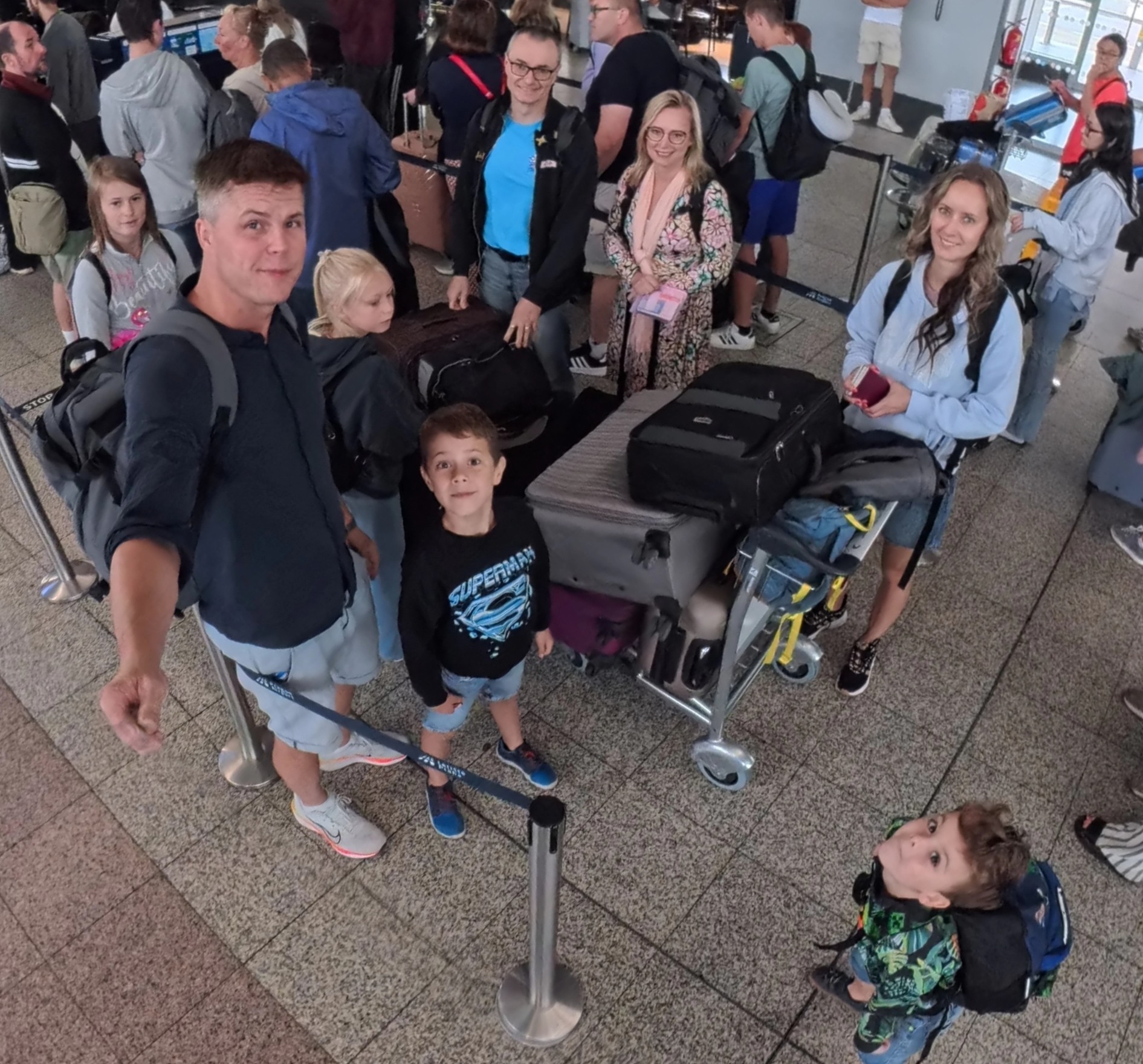
During final packing into a limited number of bags, I organized items in suitcases to make everything fit. For this I used the lid of the original SunSDR2 DX transceiver box, which covers the bottom half of the box, acting as a "dimension template". I got everything arranged and knew exactly where everything went. Later I loaded all the luggage into the car. As I walked through the hamshack right before leaving, I stared in disbelief at the desk where the inner box with the radio was still sitting! I had to pull the suitcase back out of the car and pack the actual TRX instead of just the lid.
At the airport we were among the first passengers for our flight. When arriving at the check-in desk, the staff informed us that Ryanair's systems were down and everything had to be looked up and written by hand – every single checked bag (we had 8 of them), plus Laura (my daughter) had no generated boarding pass, so hers was handwritten too… A throwback to pre-computer times with paper tickets. Processing just our group took 20 minutes…
Boarding the Ryanair flight, we walked through airport corridors toward the bus taking us to the apron. There were 8 of us, including 4 kids, quite a chaos, moving through the crowd at a pace of one meter per minute. Suddenly I froze – where was the suitcase containing the radio and notebook? Guess what! It was left standing in the corridor before the escalators leading to the airport "ground floor" – fortunately everyone ignored it and didn't hand it over to bomb disposal.
On the plane, Vaclav and I sat together fine-tuning our strategy. We studied analysis of older log files and the latest CONDX forecasts. One finding was that in past WRTCs top-placing teams stayed on 20m almost continuously. The propagation forecast also predicted that 20m would be open round the clock. Vaclav came up with a strategy where one of us would remain permanently on 20m while the other worked the other bands. The reasoning made sense – if it's true that you need to be on 20m all the time, that operator gets familiar with the band and maintains a solid overview. We agreed on this idea, leaving who would take that role to be decided later. We also agreed it would be good to start the contest on SSB.
After arrival and picking up our rental cars (we each rented from a different company), we met at McDonald's and then drove to the WRTC HQ in Wyboston, about a two-hour drive. The resort is beautiful and huge, except it wasn't built for temperatures around 35 °C – the rooms have no air conditioning… At least there was air conditioning in the common areas where we spent most of our time – in fact, we had to put on extra layers because the resort subscribed to a US-style philosophy of "the colder, the better". Sleeping was a problem; despite open windows and fans, it was tough…
For financial reasons, we housed our families in a nearby cottage (approx. 4 minutes by car) via AirBnB. They had a nice yard with shade and grass, but no air conditioning either – classic England, where high temperatures aren't common yet.
We knew the tents we'd be in had no groundsheets and that the organizers would provide low chairs. We weren't thrilled with that, so we decided to solve it locally. At a nearby Tesco we bought comfortable aluminum patio chairs made of synthetic rattan, and at a local hardware store a tarp for the whole tent floor and a rug under the chairs so they wouldn't puncture the groundsheet. Although we looked like eccentrics moving to the site, everyone envied us :-) and even the referee told everyone after the contest how well-prepared we were :-)
On site before the contest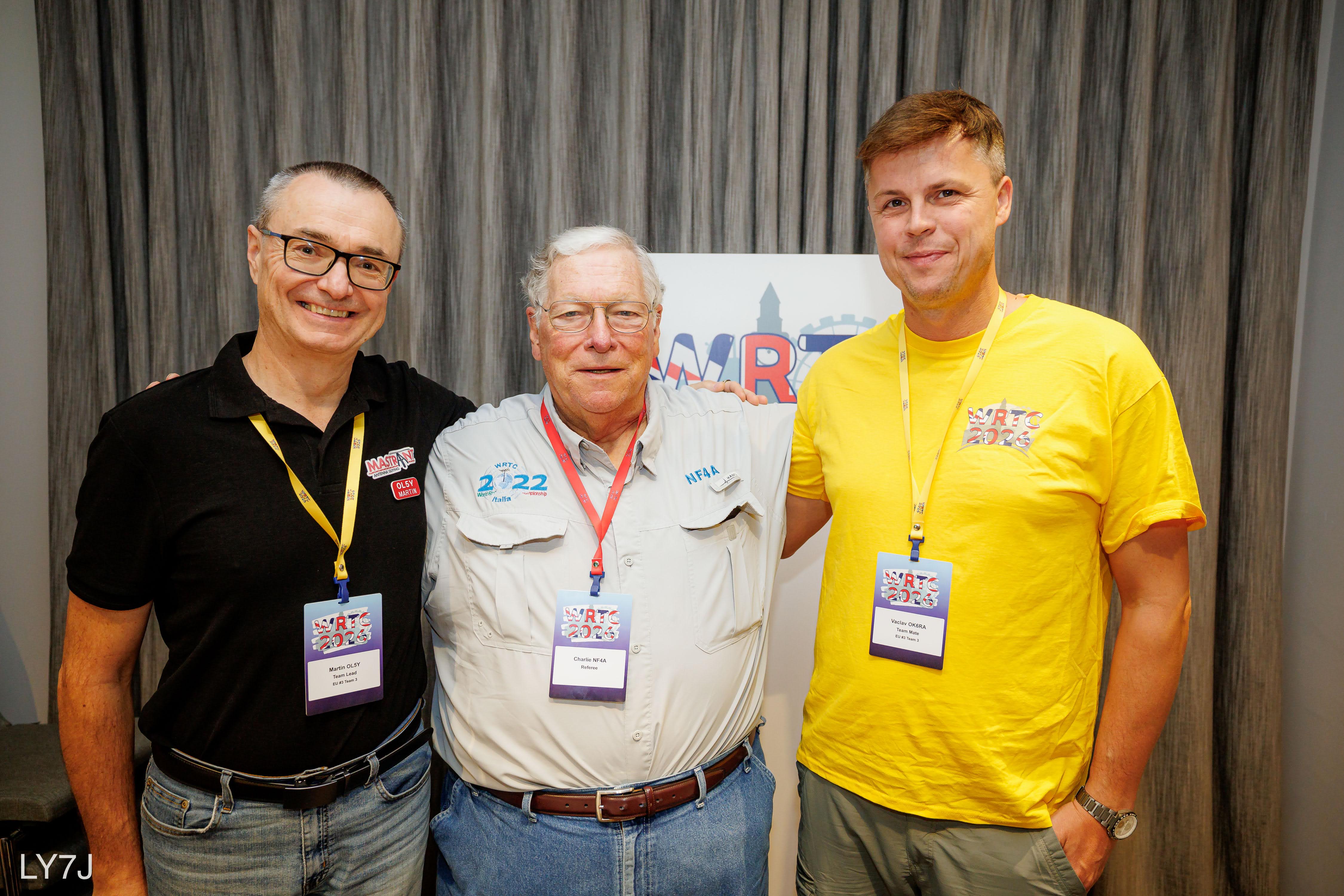
On Friday morning we drew our referee (Charlie NF4A), the envelope with our Call, and our tent, drawing around 7th in order (draws started from the most distant sites). By a strange coincidence, we drew a location right next to the Slovak team OM2VL/OM3RM, so we travelled in the same minibus and could chat with Laci and Tibor. The drive took 1:20 hours. First we dropped off our neighbors – they were in a mowed field on a gentle slope with no vegetation around (apart from weeds). If they were 100 m further "uphill" it would have been better, but even so it wasn't a disaster (not counting the dark blue tent and scorching heat). Nearby was a small hill with another antenna right on top – we started feeling envious, as we knew from the map that it wasn't ours, realizing immediately that differences between QTHs would be significant. We continued to "our" site. When we turned off the road onto a dirt track down a gentle slope towards a nearby copse, our spirits began to sink… A location no HF contester would ever choose voluntarily. I tried to lift Vaclav's spirits with Google Maps showing a marsh a few dozen meters from the tent… His reaction was funny: hmm, mosquitoes… Our consolation was supposed to be hiding in the shade of the surrounding trees and bushes. Vaclav adds: But if only they surrounded us; they surrounded the antenna on all sides too. A small clearing in the middle of a forest that you'd never voluntarily pick for radio operating. Remarkably, there aren't many such copses in this area of England. With low power, among deciduous trees, and in a hollow, all that was missing was rain to "improve" the signal even more. After the contest I received an email from a HAM asking how it was possible there was such a big difference in signal strength between individual WRTC stations. This might be one explanation.
So we made good use of the shade from the trees. And we didn't need to pitch a toilet tent either :-) You can see where we were located here: https://what3words.com/statement.grills.crunch
After unpacking the bare necessities, Vaclav grabbed the analyzer and jumped straight onto the prepared antenna cables. And what would you expect after that dramatic introduction? The 80m dipole wasn't working – measurements indicated one leg was disconnected. A phone call from the referee to the site manager followed. He arrived a few minutes later, holding his head in despair, wondering what to do since we couldn't fix it ourselves. Given that we are seasoned portable operators, our intuition told us clearly that we had to fix it ourselves right away as a trio (with the referee watching from the shade of the tent). We decided to lower the antenna and attempt a repair. Fortunately there was no wind, so it wasn't overly complicated. The fault turned out to be a loose contact in the cable connector at the balun. After cleaning it, everything was OK. Once raised back up, all antennas were working fine. We just lost over an hour because we halted all setup work thinking we might have to relocate to a different QTH.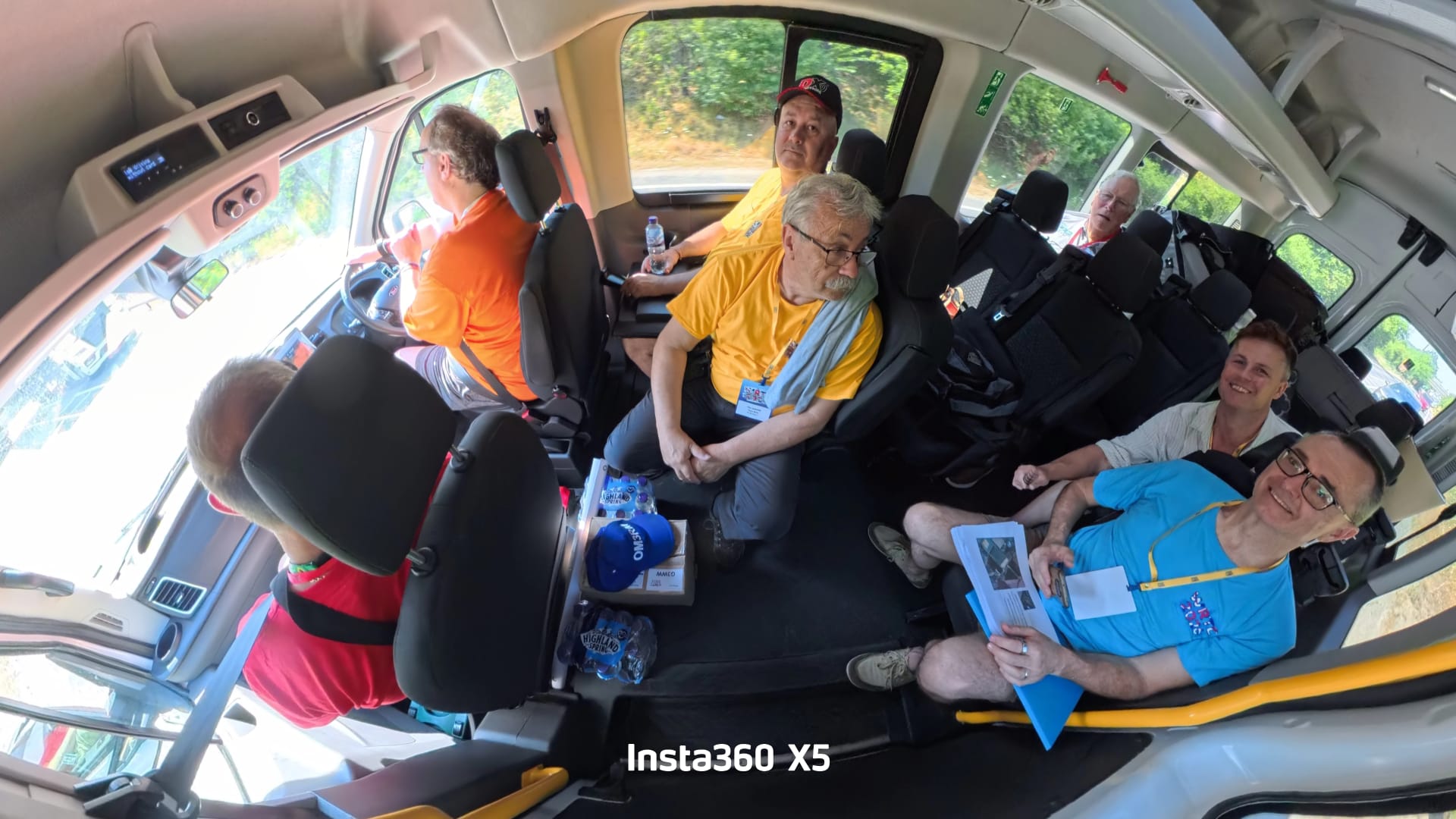
During preparations we learned that a vehicle would pick us up at 3 o'clock – this panicked us since we hadn't even connected everything yet, let alone tested anything…
Another issue occurred when we unpacked the "reporting computer" (provided by the organizers, built back for WRTC 2022). It is a device that "reads" data from the competitors' PCs and sends it to headquarters to generate the online scoreboard and automated spotting. For those unfamiliar, a brief explanation: to minimize the effect of "cheerleading spots", a system was developed prior to the previous WRTC to spot all competitors equally fairly – after 2 SSB QSOs made on the same frequency, the system should automatically send the callsign to the DX cluster and repeat this every 10 minutes. For this year, the system was developed within the World Radio League (WRL) platform, which also provided the online scoreboard and media content during the contest.
Back to the "reporting computer": it uses the GSM network to transmit data (it has two small antennas attached). When trying to plug in the RJ-45 connector for the switch connection, the port on the computer box slipped inside. Clearly someone had filed a hole larger than the connector required… The referee allowed me to open the PC. I snapped the connector back into position and connected the cable. Additionally, I noticed that the lead from one of the external antennas was unplugged from the internal modem… Likely shaken loose during long transport. Luckily we discovered this quickly thanks to the poorly cut connector port. Upon boot-up the computer connected and everything worked.
When we wired up our audio mixer just like during ARI contest testing, we found that the output signal for one operator was permanently mixing signals from both radios. Outputs for the referee and recorder were also acting strangely. Vaclav disassembled it to see if there was an issue with a connector. He eventually found a broken lead on one of the potentiometers. He soldered it back, and it began working properly. However, only until the referee plugged his own box into our unit. His box was supposed to let him choose which radio to monitor, or both in stereo. After connecting his selector switch, the second radio's signal was faintly audible in one operator's headphone output. We were bewildered – after all, the main point of the audio mixer was to achieve full isolation and independence of outputs… :-( We were quite frustrated – we had already spent over two hours on unexpected repairs. The referee watched on puzzled. Then someone suggested plugging him into the audio recording output – and lo and behold, the issue disappeared and we breathed a sigh of relief.
A rather funny moment happened with the dual monitor stand I had purchased for this event and hauled all the way from the Czech Republic. The monitor (a beautiful, lightweight, ultra-thin 19" display) I mounted on it was too light, and even with the tension spring set to its lowest setting, the monitor kept sliding up to its highest position. Fortunately, this was solved by a PET bottle filled with water tied to the back of the monitor.
When we finally wired up the radios and all peripherals, we started transmit testing. I switched to SSB, stepped on the foot switch – and alongside my voice, I heard some chirping. Not much, many people wouldn't even mind, but it bugged me. Luckily, the SunSDR has incredible input audio processing capabilities, so using very sharp notch filters I managed to suppress it almost entirely without affecting my modulation. According to reports from nearby stations, it sounded "super".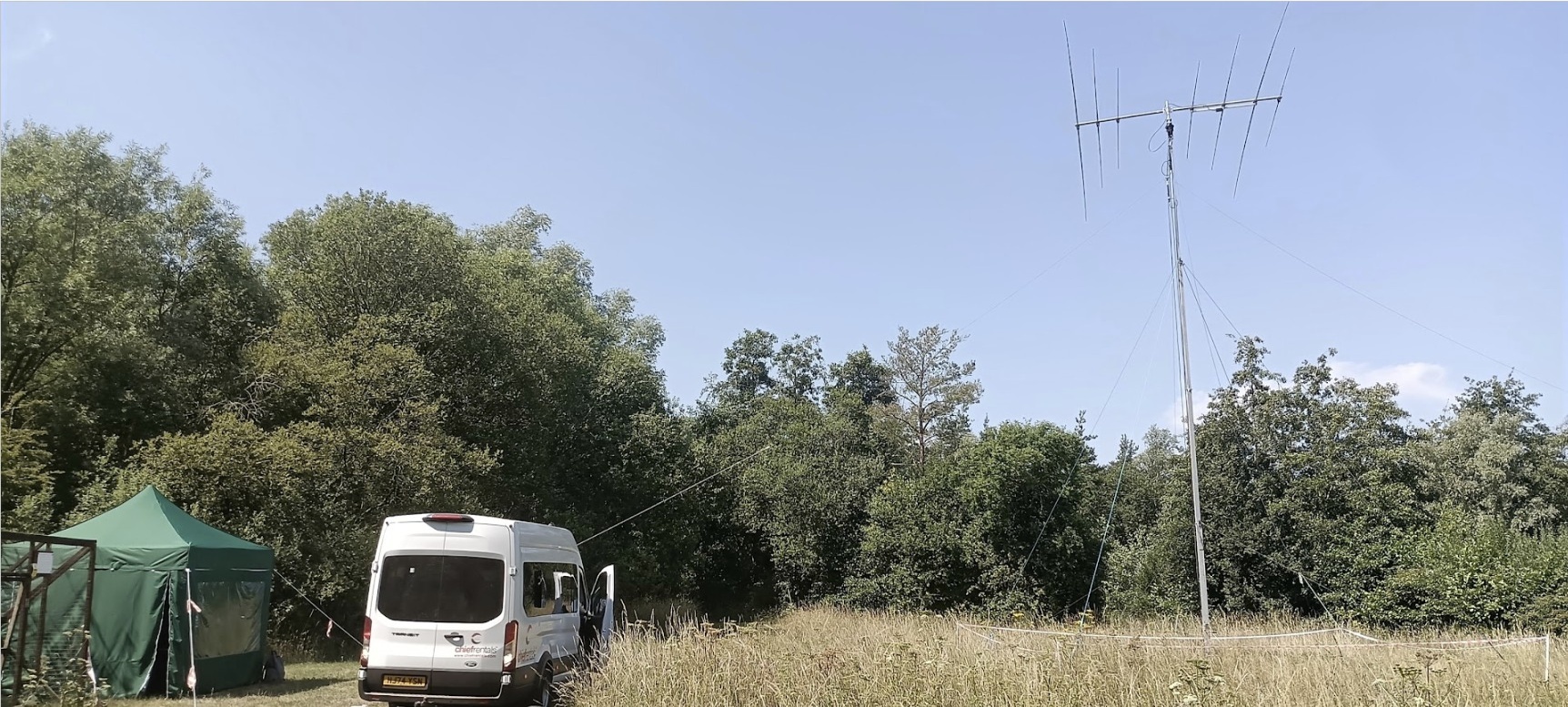
We made about 5 QSOs and had to start packing up again – nobody guarded the tents overnight and we didn't want to leave anything expensive behind. We left knowing we still had plenty of work ahead.
Even though we had tested everything many times, during on-site testing our key SW SunBridge from Vaclav didn't work as intended (and especially how it worked in tests) – specifically, automatic antenna switching from my radio was failing. That effectively settled what we hadn't known until then – who would operate 20m :-) Nevertheless, Vaclav wanted to get to the bottom of it and spent the evening and part of the night tracking down the bug and compiling a fixed version. Since I couldn't help him with that, I tried to get to sleep as early as possible. Having slept terribly the previous night due to the heat, I fell asleep easily. In the morning I was delighted by Vaclav's announcement that the problem was resolved.
The Contest
In the morning we left as planned an hour later than the others – Laci, Tibor, and I persuaded Vaclav that there was plenty of time before the contest started and that we should get as much sleep as possible. That succeeded not just according to how we felt, but according to our Oura Rings as well :-) On the way we did a quick grocery run at Tesco, which was enhanced by a funny episode when our referee casually walked out of the store holding a stainless-steel shopping basket.
We reconnected everything and began final testing and preparations. I no longer recall everything we dealt with amidst the stress and intense heat. At 11:44 our referee Charlie came over to collect our phones and wanted to open the envelope with our callsign. That was quite a shock, but luckily we quickly realized the mistake wasn't ours this time and we actually still had an hour left…
During that hour we were preparing the audio recording, among other things. We both use the Sony ICD-PX370, which we find ideal for our purposes. It is powered either by two AAA batteries or via an integrated USB-A connector. Vaclav reports his isn't powering on and he can't find his extra batteries, which he brought in abundance but were stashed somewhere. I lend him my spares and plug in my recorder. I put in new batteries, but my recorder won't power on either. It feels like a bad dream. I recheck the batteries, try another pair – nothing. After a moment I notice I'd put them in backwards… If only all problems had solutions like that.
Right before the contest we quickly grabbed a bite, placed food and drinks within arm's reach, and waited for 12:45 UTC. The callsign MB3W revealed in the envelope wasn't MB5Y, but we liked it. We configured our logging software and recorded the DVK messages. On my end this involved a rather complicated process because, for reasons we haven't uncovered yet, my installation of all that software behaved differently. In the middle of all this, my headphone earpad popped off – nothing major, but under stress with shaking hands it's awkward to snap back on… :-)
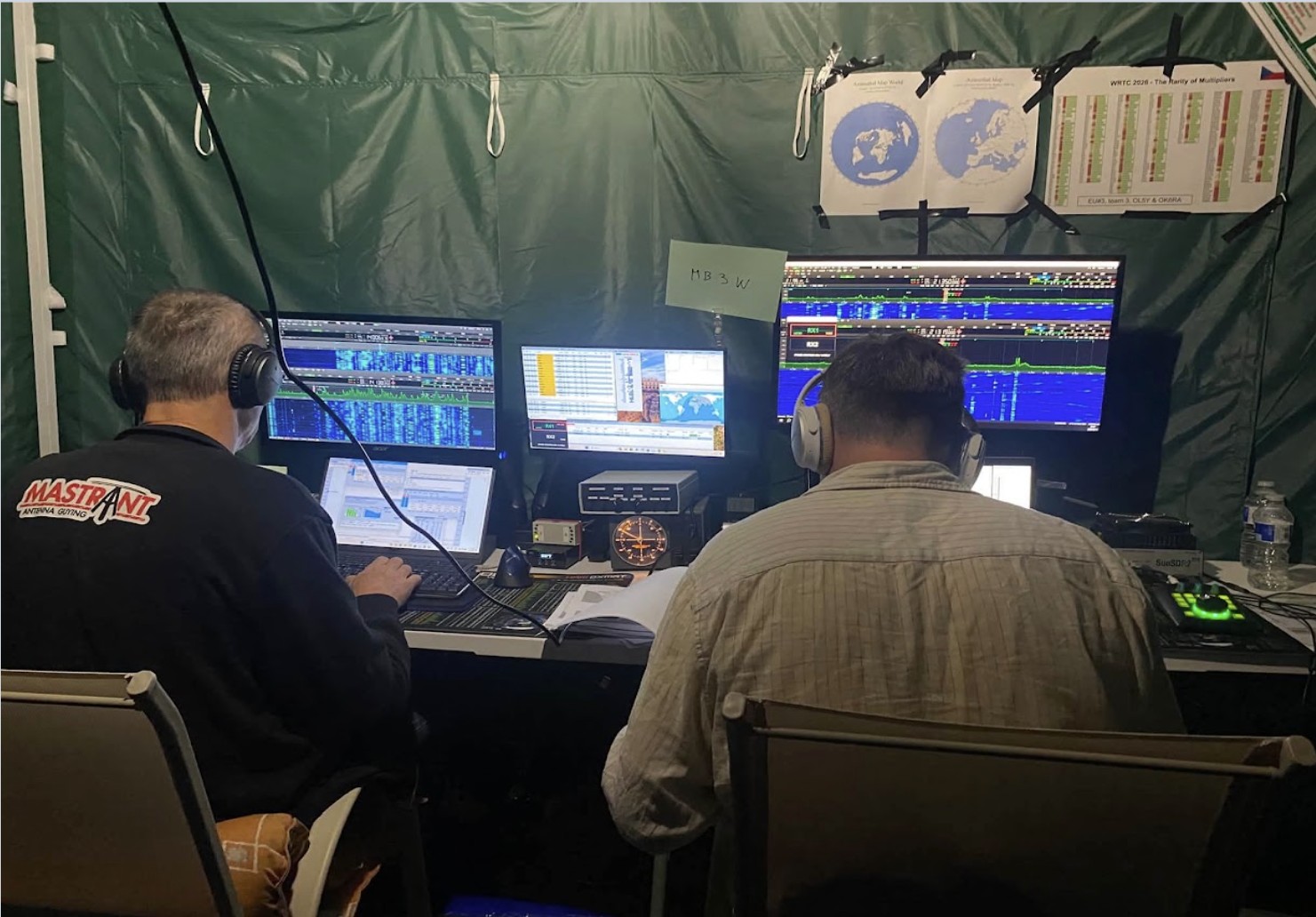
The contest started. I find a clear frequency on 20m SSB and trigger CQ via DVK. Immediately my first station calls, a Polish station. Super. Just one more QSO and I'll be in the cluster, I tell myself. I hit the foot switch and nothing – PTT engaged, but no audio from the microphone. The Polish station keeps calling, I still have nothing. I panic and don't know what to do. To make matters worse, I hear Vaclav's radio fairly loudly in my headphones… I abandon the Polish station, yank my headphones out of the box, grab a simple Y-splitter (so the referee and recorder can hear my audio), and plug directly into the radio. I hear only myself, phew. Charlie taps my shoulder saying his audio is too quiet… So I crank up the volume to satisfy him, but then I'm uncomfortable because the deafening roar is unbearable. He understood, and in the end we agreed on a compromise.
And what now with SSB? I call out to Vaclav, who is buried in a pileup on 15m, asking for advice. Run CW, he replies. Great, I could have thought of that too… Well, onto CW. Five minutes into the contest I log my first QSO!
Naturally, it keeps bugging me – after all, it worked! Likely a bug in the late-night version, I have no other explanation. On RX2 I have the SSB band displayed and remembered that during testing RX2 behaved differently than RX1 in certain situations. So at the first free moment I try switching to RX2 and hit the PTT switch – boom, my voice is there! In minute 52 I make my first SSB QSO with MB7F. Unfortunately, I discover that DVK doesn't work on RX2 instead… What I feared, despite huge efforts and troubleshooting, was realized – I'll have to operate using my raw vocal cords. Oh well, I've got to push through!
We stuck to our "20m strategy" for 92 minutes :-) After that, knowing that 15m was open brilliantly and shouldn't be abandoned, we agreed I should go to 10m instead. It wasn't amazing, but at least added plenty of multipliers. After an hour I tried SSB – it went nicely for a bit, but it was obvious automated spotting wasn't working :-( At 1545Z I returned to 20m and our original strategy – and as I found out after the contest, unfortunately right at the exact moment 9A5CW spotted me in the cluster… :-( I left 20m several more times later on.
One could write at length about the contest operation, but it would be uninteresting. We experienced massive pileups with short-term rates over 300 (CW) and even 400 on SSB. We also experienced moments when things stalled and we didn't know how to proceed. Decisions regarding SSB were particularly tough. We suspected there were issues with automated spotting (our referee, unlike others, unfortunately gave us no information), yet we trusted that it was "somehow" working and that someone/something would spot us. Operating on that faith, we wasted several minutes of precious time calling CQ fruitlessly.
We were greatly encouraged by the fact that our total QSO count was above the winners of the previous WRTC. We got through the night without a single slump, in my case powered by two warm mango Monsters and a delicious risotto prepared right before the contest by my wonderful wife Jana OK3FLY.
It was sweltering inside (we had to close the tent due to harsh sunlight and wind). After sunset it cooled down dramatically, reportedly to 17 °C. We were freezing even though we put on every piece of clothing we had brought, including two pairs of socks. Shortly after the sun came back up, the situation reversed and once again, amidst full operation, we were peeling layers off…
Vaclav adds: Regulating the temperature in the tent took up quite a bit of my time. With other teams the referee handled this, but in our case it wasn't possible for health reasons on his part. I had to pause operating several times to open and close various sides of the tent in a rather complicated manner. So even our original intention of never stepping away from the radio even to relieve ourselves went out the window, and whenever I went to adjust the tent climate, I stopped by the woods on the way to answer nature's call. Martin managed it with a wide-mouth bottle at the radio once, almost unnoticed :-).
In the morning the light suddenly dimmed, the radios shut down, and it was clear something was wrong. We hoped it was just fuel that our site manager forgot to top up. And yes, that was it – using a manual bulb pump, I refueled the generator to overflowing. And I did that twice more just to be safe when I had to take a "bathroom break" after a dose of energy drinks.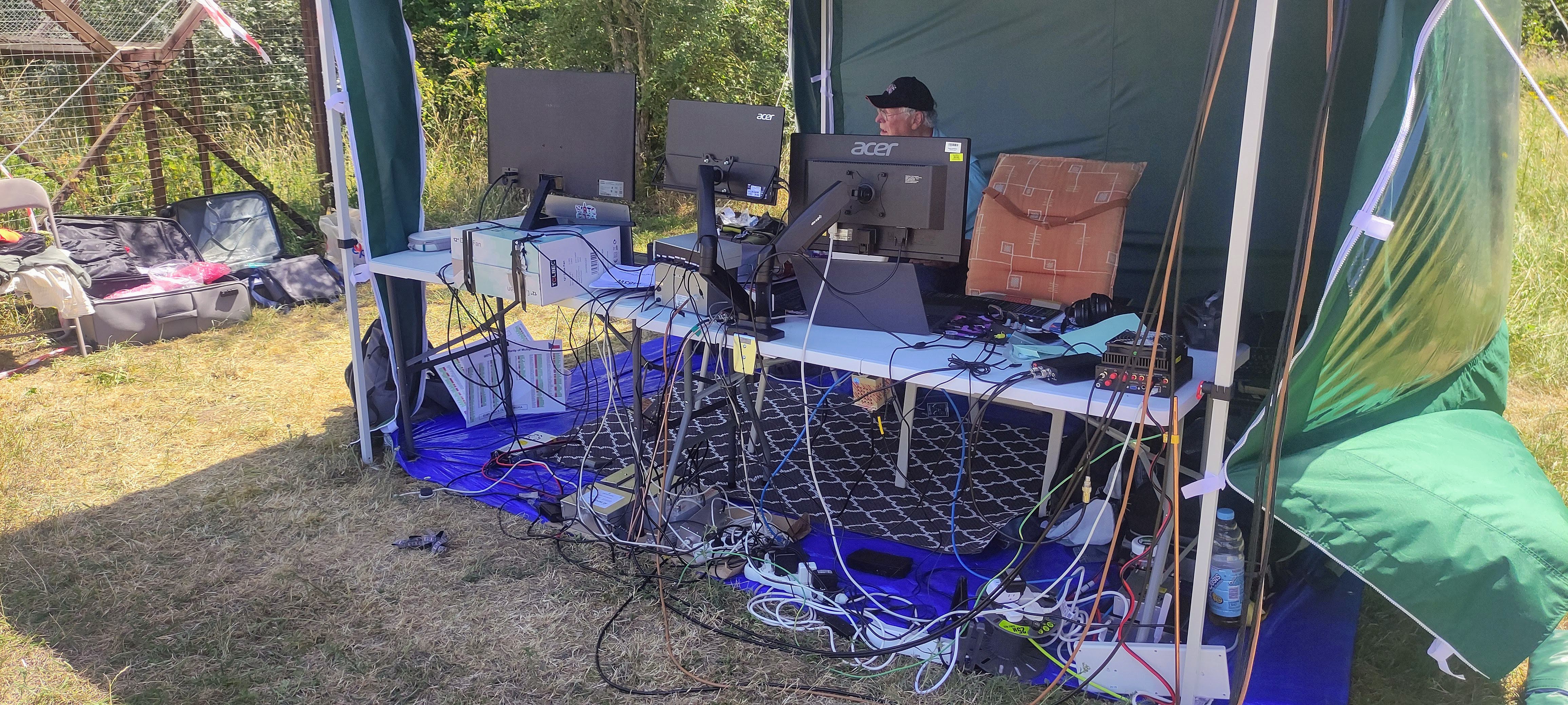
Our referee Charlie monitored us dutifully during the contest – even though he sometimes had his eyes closed. Occasionally he stood up and leaned against our chairs – which we definitely felt every time :-) Right after we took off our headphones, he told us that in the first hour we were in 40th place, but pulled it up to 25th, and congratulated us. Well, we weren't happy. More precisely, we were quite upset. After all, we had logged 300 QSOs more than the winners of WRTC 2022… It threw us off so much that we forgot to photograph our setup as it was during the contest. We have one picture when part of it was already disassembled… Pity.
When we packed everything up, our minibus arrived mentioning we still had to load part of another team. So we drove to another site and waited around, making the trip back to HQ take over two hours.
As soon as we arrived back at the hotel, we started investigating spots (nothing else was available at the time). We found that automated SSB spotting worked better for some (MB5Y - 97 spots), and unfortunately not at all for others. We "received" 39 automated spots, which is roughly average. We were annoyed by obvious unfair support from certain direct participants. Specifically DM9EE, a member of the E7DX support team who drove them and assisted them on site before the contest, set up an antenna near station MB1I (team E7DX + DJ4MX) and spotted stations highly selectively – "his" team by far the most (9x) and stations that could challenge them not at all or only once… Anyway, as you will read below, that was far from the worst thing happening.
Cheating
Even though WRTC should be the "fairest" amateur radio competition, efforts by some participants to gain an unfair advantage still manifest. What happened at WRTC is just a more sophisticated way of achieving a better placement through cheating. Many "top" stations in our community shamelessly claim that almost everyone cheats and that it's completely normal in the EU. Sentences like: "Show me a single station in the TOP 5 in EU that follows the rules!" or "I must run 3 kW because otherwise I stand no chance," I hear all too often. I am not surprised at all when someone devises even more "effective" ways of bypassing rules. Rules are either followed or not (and then fair competitors are cheated) – there is no middle ground.
After WRTC 2026 concluded, participants traditionally began analyzing publicly available logs. A group of experienced contesters noticed unusual behavior from several DX stations providing rare multipliers. These were callsigns YV1LBB, 4F3OM, 4S7KM, HZ1TT, 4K6FO, TI1W, HC5AI, HL2CFY, 9M8YY, 9M2LAN, ZP5KO, and ZS6WAR.
Common traits of these stations were: operated CW only, did not submit logs to the IARU HF Championship organizer for evaluation, didn't run CQs and only searched, made only a small number of contacts, and gave out attractive and rare multipliers. And very selectively so: MB2M ("winner", VE3DX and UW7LL) – 28 multipliers, MB2A (US2YW and IK4VET) – 24 multipliers. For comparison: other top teams scored at most around 11, the second-placed team overall MB5O gained only a single such multiplier, and the same was true for us.
A timeline of all QSOs with suspicious callsigns was put together. The result: one callsign appeared, disappeared after a few minutes, followed by another rare DXCC multiplier appearing, then after a few more minutes yet another callsign. It looks like a single operator changing identity during the contest. During the "investigation", the WebSDR Graz recording archive was available, allowing back-listening to suspicious signals. From this and RBN data, unusually strong signals from these DX stations on the 40m band were also noted. The community leans toward the assumption that the pirate was someone located near the event venue.
Within the community there was much discussion on how to identify individual teams. Anyone who thinks through it carefully comes to the conclusion that it can be done in several primitive ways. However, this year it was even simpler. After the contest, it was discovered that the WRL online scoreboard server, which contains the CALL-to-team assignment, had a security flaw and with a relatively simple script, all callsigns could be identified in a matter of seconds.
Following the publication of these analyses, the WRTC 2026 organizing committee issued an official statement. It confirmed that discrepancies were found in the logs, that they could affect the final standings, and that judges were instructed to perform a complete re-evaluation of the competition. WRTC 2026 Chairman Mark M0DXR stated that maintaining fairness and competition integrity is a priority and any attempts to manipulate results will be addressed.
Cheerleading
The word "cheerleading" is used in contesting to describe unsportsmanlike (unauthorized, selective) support of one or several participants. In our context, these are activities that are not illegal in themselves, but have (or can have) an impact on the result, often a dramatic one.
From our perspective, the most blatant form of such unfair support is spotting, especially on SSB. The WRTC organizers are aware of this, and in the last two WRTCs they attempted to equalize it through automated spotting (described in the previous paragraphs). Unfortunately, that didn't work as it should have. We heard opinions claiming "it doesn't have that big an effect". Because our impressions differ fundamentally from that view, I ran a data analysis on our log and spots. I worked on the premise that a spot impacts the number of calling stations for a duration of 5 minutes following the spot. One can certainly debate whether 3, 5, or 10 minutes is appropriate, but I had to start somewhere and chose 5 minutes. So operation within 5 minutes of a spot was tagged as "supported" and all other time as unsupported. During supported periods, our average rate across the entire contest was 2.6 QSOs per minute, versus 1.2 QSOs/min in unsupported periods – meaning a spot more than doubled our rate! For those interested in endless reflections on this topic :-) I add two more factors: 1) Rate depends not only on the volume of callers, but also on operator skills. 2) When there are too many callers, even top operators see their rate drop.
Above I outlined the numbers from our log. Now what to do about it, right? Every competitor I discussed this topic with at WRTC agreed that self-spotting should be permitted directly by competitors with a frequency limit of spots (e.g. every 5 or 10 minutes). Technically this is no problem and can be easily monitored during the contest – if someone violates it, they receive a warning; if repeated, penalties kick in.
And now for another classic phenomenon – support through selective calling. Here are several examples from this year's WRTC showing what I mean (in each case listing how many QSOs were logged with which station):
- DA0BCC: 9x MB1I (E77DX+DJ4MX), others 1-3 QSOs
- DP4X: 9x MB1I, others 1 QSO
- DJ2MX: 8x MB1I, others 1 QSO
- M/DM9EE: 6x MB1I, 5x MB3M (JA1BJI+M0CFW), others 1-4 QSOs
- DF0WA: 10x MB5O (DJ5MW+DM5EE), 5x MB1N (DL3ON+EI5LA), others 1-3 QSOs
Either this is a coincidence (hard to believe), or there was massive targeted support for selected teams.
Why is this tolerated at WRTC? Sophisticated breaches of fairness via pirate stations described in the previous chapter, along with cheerleading, are major topics among people interested in WRTC. Personally, I think it represents a failure of the "refereeing" team – not the ones assigned to individual teams, but the "Judging Committee" (this year N6AA, M4C, G0CKV, W6OAT, N6TR, N5KO). They turned a blind eye to obvious problems for reasons incomprehensible to me. At the same time, it is also a fault of the community – those who had suspicions or even clear data did not speak up publicly. I am no longer a programmer (even though I made a living as a programmer for many years), but I know something about IT, so I don't understand at all why the judges didn't utilize data available from minute one of the contest. They had information on every QSO made, just seconds after it was logged. If a few skilled enthusiasts (or even just one) had been working on it, it could have been clear what was happening within a few hours of the contest start. Not to mention that alongside the logs, data from RBN, DX clusters, and SDRs at numerous locations were available… Even individuals attempting to bend the competition's fairness right in the WRTC event area (e.g. DM9EE) could have been warned on the spot that what they were doing was not OK. I believe the Judging Committee is now under such tremendous pressure that their approach will be reassessed – and hopefully fresher (and smarter) people will be involved in the process. There is also discussion about involving the whole HAM community by publishing all logbooks right after the contest. Still a mystery to me is the stance of the so-called Sanctioning Committee, which approves WRTC hosts and rules, as well as presumably the Judging Committee.
Lessons Learned ("should another opportunity arise…")
First regarding the organization. Although we described several inconveniences and oversights attributable to the organizers, we want to state unequivocally that the entire event was planned and overall organized absolutely fantastically. The organizing team put in an immense amount of work. Even though management faced constant criticism before the event for various things, often complete nonsense, they handled it brilliantly, calmly, and with perspective. In my eyes they are heroes, and I believe I speak for Vaclav too when I say they provided us with wonderful memories that will stay with us for the rest of our lives.
And now regarding our performance :-) Vaclav and I spend a lot of time analyzing why we didn't perform better. We examine inputs, conducted plenty of breakdowns and analyses, and thought about details. What came out of it?
I think the N1MM + SunSDR2 + SunBridge setup was perfect. Setting aside the (certainly solvable) DVK issue, it gave us a noticeable edge. Being able to visually monitor the second mode on the waterfall and easily switch audio and jump back and forth was great. We definitely didn't utilize it to its full potential, which can be improved with practice. Another option is DXlog, which Vaclav and I are considering – N1MM's strange behavior and instability often drive us crazy.
Another area needing improvement is accuracy. We had more errors than we would have liked. Our admiration goes to team MB4G (N6MJ+KL9A), who had 0.4% error rate (we had 1.7%, more than 4x higher). It's hard to say whether any single error type predominated – sometimes a silly typo or transposed letters (especially on SSB), other times a weak, unclear signal. On CW I tend to confuse 7 and 8. Improving this comes down to practice and the discipline of "asking when unsure, even if it slows me down".
And finally, a topic that offers no lesson and is purely down to luck of the draw: QTH. The quality of a QTH shows up most directly in the signal strength generated by the station. Naturally, other factors matter too, especially QRM levels, though as far as I know that wasn't an issue anywhere this year. The CW4EVER server (link below) includes skimmer data that can be sorted, compared, and analyzed. Such aggregated data cannot tell the whole story because it doesn't account for time stamps, but relies solely on statistical processing of input data. Another unknown is antenna heading. Nevertheless, one can still read from it that differences existed, mostly by a few dB. And also that they don't correlate with final station standings at all – for example, unofficial winner MB5O (DJ5MW+DM5EE, after removing pirate QSOs) had the second-weakest signal on 80m in EU (-3 dB compared to the strongest). But to inwardly "justify" our result a bit :-), here are a few numbers about us (in each case compared to the average of the 3 strongest stations per skimmer continent):
- 80m: -2 dB EU, -14 dB NA
- 40m: -2 dB EU, -5 dB NA
- 20m: -3 dB EU, -3 dB NA
- 15m: -2 dB EU, -5 dB NA
- 10m: -6 dB EU
Vaclav adds his feelings: Immediately after the contest ended, when the referee informed us we were likely in 25th place, I didn't feel great. However, with hindsight and considering the facts above, it was a truly unique experience. Martin knows many contesters personally from trade shows through his company Mastrant, but for an ordinary ham radio operator it is like a mini holiday – meeting the best of the best in person. The social dimension of the entire event is one of the main reasons why one stores this memory forever.
In all likelihood, the standings of many stations will still change (at this moment we are awaiting the official review of results), but one thing is clear – far more training is needed. Luck is a wonderful thing, but it won't win WRTC for you. Every team had its own problems. Someone had to air out their tent, someone had ants crawling into equipment, someone had their tent caught by wind, a tractor was driving behind someone's tent, sheep walked into someone's tent, cows were mooing near someone's antenna, etc... So one must expect that problems will always occur, and excuses about external factors (cheating aside) aren't such a significant part of the result. What matters most in this competition is how good an operator you are and how well you can handle unexpected situations that arise. That is what decides this unique amateur radio competition.
Thank you Martin for letting me be by your side! It is an honor to be your friend. Thank you to my wife Iva for being so tolerant when I pack up for at least 8 weekends a year, leaving full care of our two great little boys solely up to her.
Finally, I want to thank Vaclav, who is a fantastic friend and an amazing operator too :-) And in no small measure, I thank my wife Jana OK3FLY for her incredible tolerance and often support :-)
Sources of further information
For those who would like to know more, here are useful sources: www.wrtc2026.org, https://cw4ever.eu/trainer/WRTC-2026-Complete-Analysis.html, https://groups.io/g/wrtc2026-discuss, www.wrtc.info.
Addendum
On September 1, the WRTC 2026 organizers released revised results based on a detailed investigation by the team of judges and other external collaborators. They published a very detailed report on this, which is available on the event’s website. I’m thrilled that they had the courage to disqualify the four teams found to have violated the rules. This is great for restoring integrity to the WRTC. The disqualified teams were originally in 1st and 3rd place, but also lower down—in any case, I discuss them in my article as well. You can find the details in the report mentioned above.